Showing posts with label Catholic. Show all posts

16 December 2011

Act of Charity

This post isn't easy for me to write.  On different occasions, in reading about other peoples' experiences, I've heard of something that, frankly, angers and saddens me.  It is that sometimes breastfeeding mums are admonished for openly breastfeeding at church, being told that it is an act of charity to others if they will cover or go to another location to breastfeed.  I've been ruminating over this, over the implications of it.  An act of charity to cover or move.  Is it really an act of charity?

For one, it ignores the fact that the child needs to eat when he needs to eat.  He cannot always wait, and it sometimes will create a scene to force the issue.  Yes, some can wait as they get older.  I would expect my four-year-old to wait, for instance, but would not expect the same of an under-two-year-old.

So what about using a cover?  I used a cover with Kieran until he was about 5ish months old, when I got tired of the hassle and he wouldn't tolerate being covered.  I figured out that I could actually be more discreet by nursing without a cover, since I could feed more-or-less instantly and without an obvious indication that I was breastfeeding (the covers ensure no skin is revealed, but make it obvious what you're doing, in my opinion).  I really don't know many children who like being covered to feed, to be honest.  At least not when they're older than a few months' old.

Source
What is it really saying to tell a mother that it is an act of charity to cover or go elsewhere to nurse?  I think it says that many, many people have forgotten the primary purpose of breasts: nourishing a child.  Unintentionally or not (and I try to give the benefit of the doubt and say it is unintentional), it tells mothers that they are not being discreet or modest, I  think.  I can't help but think of Our Lady of La Leche, then.  For a less stubborn or self-assured mum, it could even result in her dropping some breastfeeds or going to a different church (or ceasing to go), none of which are good options.

Finally, is it really an act of charity to cover or move for the sake of the adults who may be uncomfortable?  It would make them more comfortable, but is that the same as being an act of charity towards them?  There are times when we need to be made to feel uncomfortable in order to truly confront something, and this can in fact be an act of charity.  Charity doesn't mean we ignore our issues, or others' issues, but that we help them.  In the case of breastfeeding, I personally don't think covering or moving is an act of charity for others, for it perpetuates the skewed perception of breasts as being strictly provocative and sexual instead of being the normal way mothers nourish and comfort their children.  Again, this doesn't mean purposefully drawing attention to oneself or being belligerent about it, but simply feeding one's child when and as needed.

It should also be noted that not using a cover or moving doesn't mean exposing oneself, either.  Nursing without a cover can be done modestly.  I've stood face-to-face with a priest whilst breastfeeding my daughter, and the priest only commented that she was sleeping, so I don't think it was obvious that she was also breastfeeding.  Or maybe he just didn't care.  I personally have no problem with wearing something that can be easily pulled down at the neck, but another way of doing it is to wear a camisole under a shirt and pull the top shirt up.  While I prefer the former, simply due to ease, I could compromise and do the latter.  Another option is to feed the child in a carrier like a mei tai or wrap, though this is easiest if the child is already in the carrier and is a bit smaller.  I can still do that with Charlotte, but it isn't as easy as it once was, and since I don't usually wear her on my front, it would probably require more time and distraction.

In the end, I just honestly can't see covering or moving to be a true act of charity, for the mother, the child, or the other people.  I know I'm a lactivist, and thus my views will be biased in that direction, though I've tried to think and talk this out with an open mind.  I just wish it weren't an issue at all, especially not in a house of worship.  Our Lady of La Leche, pray for us.

14 December 2011

"Don't Shout, Mummy"

"8.42.  How'd it get to be so late?  Come, on, kids, we need to go right now!  No, Kieran, get in on this side instead of climbing over!"

"Don't shout, Mummy."

How humbling when my four-year-old is reminding me not to shout.  How much does that make me stop in my tracks and reevaluate what I'm doing?  The above scenario happens all too often, and what's worse is that it's usually when we're on our way to Mass.

It's my own fault for not getting out of the house earlier (most of the time), and in my frustration at this fact, I lash out by shouting at my children to hurry up.  This lands my in Confession more times than I care to admit.  As humiliating as it can be for my own child to say "don't shout, Mummy", it is a great grace that God has given, to give me this reminder in the voice of a child.  Yes, it's important to be on time to Mass, but I can't blame the children for my inability to get out of the house with time to spare.  I pray that God continues to give me the grace I need, and that I will be open to receiving that grace.

11 December 2011

Gaudete Sunday

It's Gaudete Sunday! That Sunday during Advent when we rejoice in anticipation of the coming of our Lord. Last night friends of ours had a lovely Gaudete Sunday party, and even had St Nicholas make an appearance, along with a family Rosary. It was very lovely.

I have an additional reason for rejoicing today, for today is the seventh anniversary of my Confirmation and First Communion! It's amazing to think back on it. I continue to be amazed atGod's goodness.

4 December 2011

Rosary Musings: Fifth Sorrowful Mystery

The Fifth Sorrowful Mystery: the Crucifixion

by Salvadore Dali
1 Corinthians 1:17-24
17 After all, Christ sent me not to baptise, but to preach the gospel; and not by means of wisdom of language, wise words which would make the cross of Christ pointless. 18 The message of the cross is folly for those who are on the way to ruin, but for those of us who are on the road to salvation it is the power of God. 19 As scripture says: I am going to destroy the wisdom of the wise and bring to nothing the understanding of any who understand. 20 Where are the philosophers? Where are the experts? And where are the debaters of this age? Do you not see how God has shown up human wisdom as folly? 21 Since in the wisdom of God the world was unable to recognise God through wisdom, it was God's own pleasure to save believers through the folly of the gospel. 22 While the Jews demand miracles and the Greeks look for wisdom, 23 we are preaching a crucified Christ: to the Jews an obstacle they cannot get over, to the gentiles foolishness, 24 but to those who have been called, whether they are Jews or Greeks, a Christ who is both the power of God and the wisdom of God.
 Having been raised in a Christian home, I grew up seeing the cross.  Seeing it so often, it was,. and sometimes still is, easy to forget how venerating the cross really does look foolish.  After all, it's an instrument of torture and death for criminals - hardly something that would normally be venerated.

Similarly, the mystery for today, the crucifixion, is hardly an event one would think of commemorating in other circumstances.  But for us, it is an amazing event, with Jesus our Paschal Lamb sacrificing Himself for us.  It seems counterintuitive, it is beyond full comprehension.

11 September 2011

Rosary Musings: Fourth Joyful Mystery

The Fourth Joyful Mystery: the Presentation in the Temple

The Presentation by Bellini, from CGFA
As always, starting with the Scripture, from Luke 2:22-38, taken from the New Jerusalem Bible:

22 And when the day came for them to be purified in keeping with the Law of Moses, they took him up to Jerusalem to present him to the Lord- 23 observing what is written in the Law of the Lord: Every first-born male must be consecrated to the Lord- 24 and also to offer in sacrifice, in accordance with what is prescribed in the Law of the Lord, a pair of turtledoves or two young pigeons.
25 Now in Jerusalem there was a man named Simeon. He was an upright and devout man; he looked forward to the restoration of Israel and the Holy Spirit rested on him. 26 It had been revealed to him by the Holy Spirit that he would not see death until he had set eyes on the Christ of the Lord. 27 Prompted by the Spirit he came to the Temple; and when the parents brought in the child Jesus to do for him what the Law required, 28 he took him into his arms and blessed God; and he said:
29 Now, Master, you are letting your servant go in peace as you promised; 30 for my eyes have seen the salvation 31 which you have made ready in the sight of the nations; 32 a light of revelation for the gentiles and glory for your people Israel.
33 As the child's father and mother were wondering at the things that were being said about him, 34 Simeon blessed them and said to Mary his mother, 'Look, he is destined for the fall and for the rise of many in Israel, destined to be a sign that is opposed- 35 and a sword will pierce your soul too -- so that the secret thoughts of many may be laid bare.'
36 There was a prophetess, too, Anna the daughter of Phanuel, of the tribe of Asher. She was well on in years. Her days of girlhood over, she had been married for seven years 37 before becoming a widow. She was now eighty-four years old and never left the Temple, serving God night and day with fasting and prayer. 38 She came up just at that moment and began to praise God; and she spoke of the child to all who looked forward to the deliverance of Jerusalem.
 I have to admit that I think I'd freak out if some random man picked up my child at Mass.  Of course, it's possible that Mary and Joseph knew Simeon, at least in passing.  I have had an acquaintance snatch Kieran from my arms when he was much younger, because he was so excited to see the baby, but of course I never heard such words as Simeon says.  I cannot imagine how I'd react hearing those words about my son.  Obviously the angel had told Mary some of the story, and she knew some more from the shepherds who came in Bethlehem, but this was new.  What must she have thought?  And of course a sword did pierce her own soul, for what mother's soul wouldn't be pierced at seeing her son suffering as hers did?

5 September 2011

Glory Be

When we first talked about the strong possibility of moving back to the US, I was sad but OK with it.  The past two days, though, I've been a bit more stressed.  I think of England as "home", and have done so from the minute I first set foot on this wonderful island.  Yes, it will be wonderful to see all the family, many of whom we've not seen for two or more years, I just wish I could stay here and do that.

So in the midst of this stress and sadness today, a couple of things have come back to me.  One is a homily I heard a month or two ago.  One of the monks from Ampleforth Abbey was visiting the parish (which is run by Benedictines from Ampleforth), and he talked about how he encouraged the students to imagine that they were late to class, it was raining, and they'd forgotten their assignment.  At that very moment, when they were stressed, soaked from the rain, annoyed, etc, the words on their lips should be the Glory Be: Glory be to the Father, and to the Son, and to the Holy Spirit.  As it was in the beginning, is now, and ever shall be, world without end. Amen.

I've been trying to do that today.  I've also been thinking of a doxology I learnt years ago: Praise God from Whom all blessing flow; praise Him all creatures here below, praise God above ye heavenly hosts, praise Father, Son, and Holy Ghost.

Does it make me feel better?  Not really, but then, that isn't the point.  The point is to give God the glory even when I don't feel like it.  I suppose it's a bit like me telling Kieran that he needs to trust that I'm not giving instructions arbitrarily, but because I'm trying to protect or help him.  I need to trust that God has a plan for all this, and whatever it is, however I feel, I will praise Him.

4 September 2011

Rosary Musings: Third Joyful Mystery

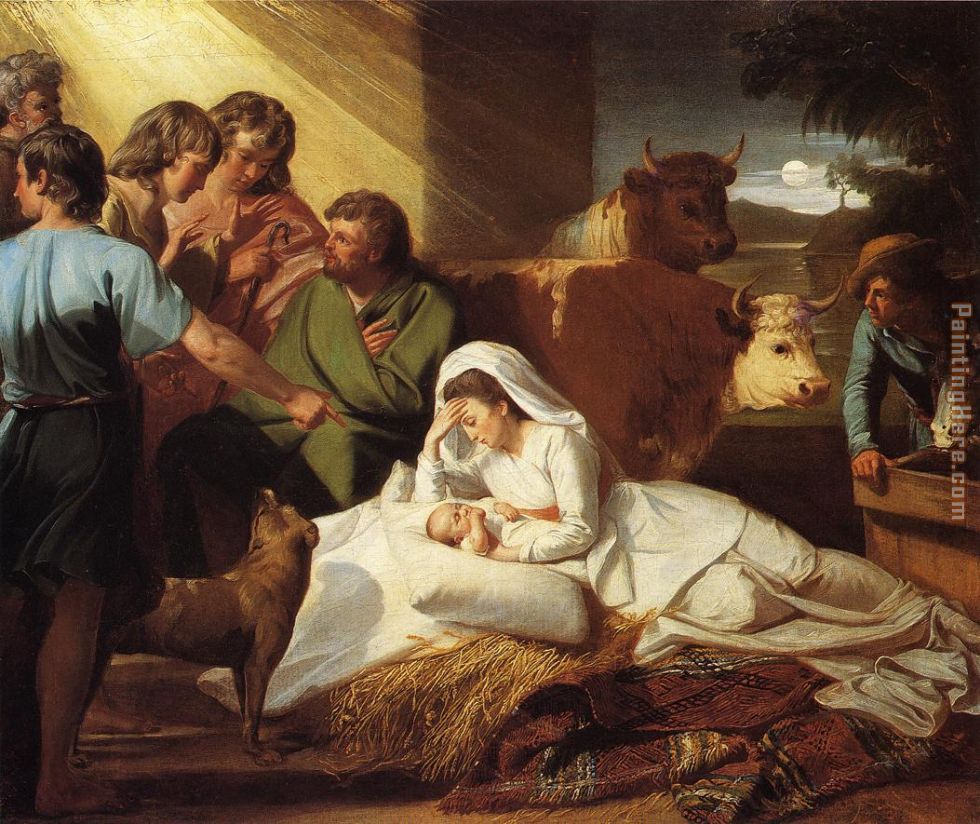
The Third Joyful Mystery: the Nativity

John Singleton Copley's The Nativity, found here: http://www.paintinghere.com/painting/The_Nativity_986.html
First the Scripture, Luke 2:1-20 (from the New Jerusalem Bible):

1 Now it happened that at this time Caesar Augustus issued a decree that a census should be made of the whole inhabited world. 2 This census -- the first -- took place while Quirinius was governor of Syria, 3 and everyone went to be registered, each to his own town.
4 So Joseph set out from the town of Nazareth in Galilee for Judaea, to David's town called Bethlehem, since he was of David's House and line, 5 in order to be registered together with Mary, his betrothed, who was with child.
6 Now it happened that, while they were there, the time came for her to have her child, 7 and she gave birth to a son, her first-born. She wrapped him in swaddling clothes and laid him in a manger because there was no room for them in the living-space.
8 In the countryside close by there were shepherds out in the fields keeping guard over their sheep during the watches of the night. 9 An angel of the Lord stood over them and the glory of the Lord shone round them. They were terrified, 10 but the angel said, 'Do not be afraid. Look, I bring you news of great joy, a joy to be shared by the whole people. 11 Today in the town of David a Saviour has been born to you; he is Christ the Lord. 12 And here is a sign for you: you will find a baby wrapped in swaddling clothes and lying in a manger.' 13 And all at once with the angel there was a great throng of the hosts of heaven, praising God with the words: 14 Glory to God in the highest heaven, and on earth peace for those he favours.
15 Now it happened that when the angels had gone from them into heaven, the shepherds said to one another, 'Let us go to Bethlehem and see this event which the Lord has made known to us.' 16 So they hurried away and found Mary and Joseph, and the baby lying in the manger. 17 When they saw the child they repeated what they had been told about him, 18 and everyone who heard it was astonished at what the shepherds said to them.
19 As for Mary, she treasured all these things and pondered them in her heart. 20 And the shepherds went back glorifying and praising God for all they had heard and seen, just as they had been told.
I can't remember exactly when, but a few years ago it really hit me about Jesus, the Bread of Life, being born in Bethlehem, the House of Bread.  It really amazes me how these seemingly little details show us something so wonderful and miraculous.  Just as Jesus came humbly in Bethlehem, he comes to us humbly in the appearance of bread of wine every single day now.  It's easy to forget that or to overlook that the same Jesus who was born in Bethlehem, who walked and lived and died and rose again and is in Heaven, is also in the Eucharist.  In fact, this reminds me of the "My Daily Eucharist" for today:

Is there any real difference between Jesus in heaven and Jesus in the Eucharist? No, it is the same Jesus. The only difference is in us. We now on earth cannot see or touch him with our senses. But that is not a limitation in him; it is a limitation in us.
We speak correctly of believing in the Real Presence. But we should grow in our understanding of what this implies.
The living, breathing Jesus Christ is in the Blessed Sacrament. This is the reality. When we speak of presence, however, we are saying something more.
Two people may be really near each other physically, but not present to each other spiritually. To be present to someone means to have another person in mind by being mentally aware of their existence, and to have them in one's heart by loving that other person...
Jesus is on earth in the Blessed Sacrament. Why? In order that we might come to him now no less than his contemporaries did in first century Palestine. If we thus approach him in loving faith, there is no limit to the astounding things he will do. Why not? In the Eucharist he has the same human lips that told the raging storm, "Be still!" and commanded the dead man, "Lazarus, come forth!"
There are no limitations to Christ's power, as God, which he exercises through his humanity in the Eucharist. The only limitation is our own weakness of faith or lack of confidence in his almighty love.
Soul Magazine
Fr. John A. Hardon, S.J
I also love Mary's response to all this.  She treasures these things in her heart.  I'm reminded that I need to meditate on these things, treasure them in my heart, more instead of taking them for granted or responding with "yeah, I know all that, OK".  Once again, Mary points me to Jesus.


28 August 2011

Rosary Musings: the Second Joyful Mystery

The Second Joyful Mystery: the Visitation

by Mariotto Albertinelli, from http://freechristimages.org/biblestories/visitation.htm
First for the Scripture from Luke 1:39-56, from the New Jerusalem Bible:
39 Mary set out at that time and went as quickly as she could into the hill country to a town in Judah.
40 She went into Zechariah's house and greeted Elizabeth.
41 Now it happened that as soon as Elizabeth heard Mary's greeting, the child leapt in her womb and Elizabeth was filled with the Holy Spirit.
42 She gave a loud cry and said, 'Of all women you are the most blessed, and blessed is the fruit of your womb.
43 Why should I be honoured with a visit from the mother of my Lord?
44 Look, the moment your greeting reached my ears, the child in my womb leapt for joy.
45 Yes, blessed is she who believed that the promise made her by the Lord would be fulfilled.'
46 And Mary said: My soul proclaims the greatness of the Lord
47 and my spirit rejoices in God my Saviour;
48 because he has looked upon the humiliation of his servant. Yes, from now onwards all generations will call me blessed,
49 for the Almighty has done great things for me. Holy is his name,
50 and his faithful love extends age after age to those who fear him.
51 He has used the power of his arm, he has routed the arrogant of heart.
52 He has pulled down princes from their thrones and raised high the lowly.
53 He has filled the starving with good things, sent the rich away empty.
54 He has come to the help of Israel his servant, mindful of his faithful love
55 -according to the promise he made to our ancestors -- of his mercy to Abraham and to his descendants for ever.
56 Mary stayed with her some three months and then went home.


The first thing I notice is Elizabeth affirming Mary as the Theotokos by calling her "the Mother of my Lord".  Of course the geek in me also gravitates towards the "blessed among women" part, since my limited experience with Biblical Hebrew and Middle Egyptian have taught me that this is how superlatives were written in those languages.

I love the description of St John the Baptist leaping in the womb when he encounters Mary and Jesus.  My children often kicked at the Consecration during Mass, and I always thought of this passage when that happened.  I also love Mary's response of magnifying God through all this.  As I mentioned last week, Mary is always pointing to Jesus, which amazes me.  I wish I could say that my every action and word pointed to Jesus, but alas, that is not the case.  I've a lot to learn.

27 August 2011

St Monica

http://www.suttonlea.org/site/stceciliasprimary/aboutus_classsaints.htm
Today is the feast day of St Monica, my patron Saint.  She's an amazing woman whose faith and perseverance I greatly admire.  She was married to a pagan man who seems to have not been the nicest, and she had three children, among them was St Augustine.  She was grieved by Augustine's wayward life and prayed constantly for his conversion, as well as praying for the conversion of her husband.  In the end they did convert, a testament to her great faith and prayer.  St Monica, pray for us.

21 August 2011

Rosary Musings: the First Joyful Mystery

Now that we've gotten through the Anima Christi, I want to go through my thoughts on the mysteries of the Rosary.  The Rosary has always been there in my life, popping up here and there long before I was Catholic.  I remember my cousins praying the Rosary, I remember a friend praying it in college, I remember getting myself in a little trouble at Sunday School by knowing and defending the Hail Mary (not exactly something a good Baptist would do).  I feel that Mary was always there, gently leading me closer to her Son, leading me into the Church and the Eucharist.  She's still there, pointing me to Jesus all the time, if I just pay attention.

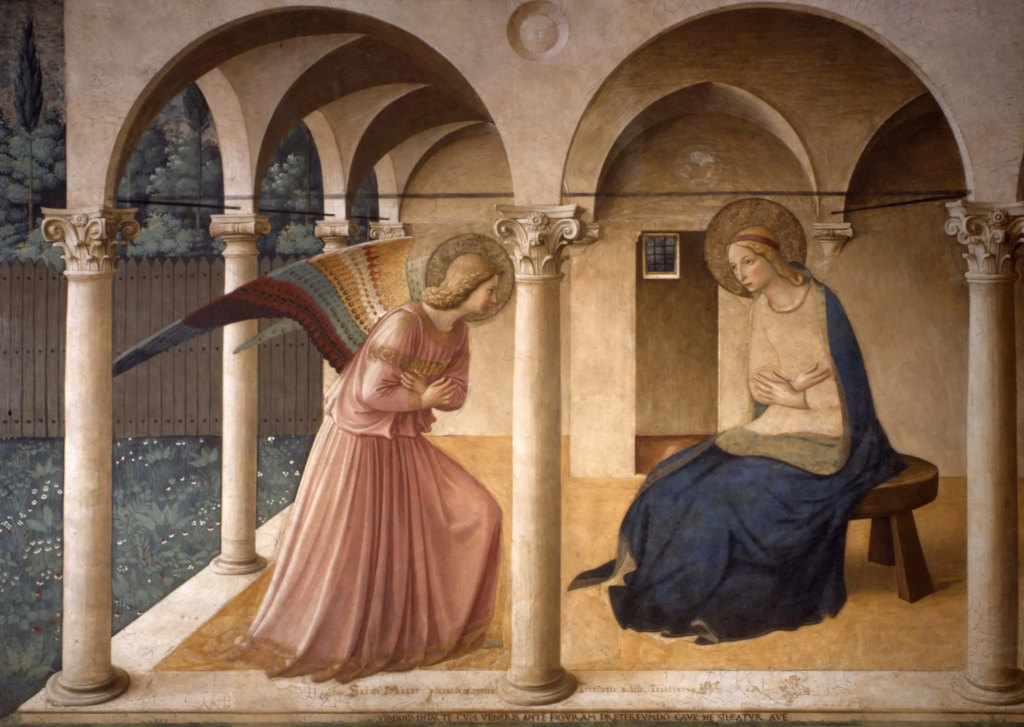
Fra Angelico's The Annunciation, from artbible.info
The First Joyful Mystery: the Annunciation 

This mystery is taken from Luke 1:26-38:

26 In the sixth month the angel Gabriel was sent by God to a town in Galilee called Nazareth,

27 to a virgin betrothed to a man named Joseph, of the House of David; and the virgin's name was Mary.

28 He went in and said to her, 'Rejoice, you who enjoy God's favour! The Lord is with you.'

29 She was deeply disturbed by these words and asked herself what this greeting could mean,

30 but the angel said to her, 'Mary, do not be afraid; you have won God's favour.

31 Look! You are to conceive in your womb and bear a son, and you must name him Jesus.

32 He will be great and will be called Son of the Most High. The Lord God will give him the throne of his ancestor David;

33 he will rule over the House of Jacob for ever and his reign will have no end.'

34 Mary said to the angel, 'But how can this come about, since I have no knowledge of man?'

35 The angel answered, 'The Holy Spirit will come upon you, and the power of the Most High will cover you with its shadow. And so the child will be holy and will be called Son of God.

36 And I tell you this too: your cousin Elizabeth also, in her old age, has conceived a son, and she whom people called barren is now in her sixth month,

37 for nothing is impossible to God.'

38 Mary said, 'You see before you the Lord's servant, let it happen to me as you have said.' And the angel left her.

Mary's faith astounds me.  I wish I always responded by just saying "let it be done to me according to thy word", but I don't.  I fight, I protest, I want to do it my way.  I have a lot to learn from Mary.

Of course, this mystery also resonates with me as a mother.  I know what joy and fear come with seeing that positive pregnancy test, but how much more would that joy and fear be magnified when bearing your Saviour in your womb?  Though without sin and dedicated to God, I'm sure she felt the full range of emotions with the message the angel brought.  In the Rosary, I meditate on these events in the life of Jesus through the eyes of Mary, and seeing God humble Himself to take on flesh and dwell in the womb of Mary and then to dwell among us: it's just amazing.  And all of Mary's words and actions point to Jesus, which is also amazing.

4 August 2011

St Jean-Baptiste-Marie Vianney

Today is the feast day of St Jean-Baptiste-Marie Vianney.  I joke that he's following me, because I seem to see him almost everywhere.  His faith amazes me.  Here's someone who struggled through seminary, who wasn't thought to be that special, but his faith carried him through so that he inspired the people around him to also follow God and love Jesus more.  I would honestly love to name a child after him (though I did realise today that I'd been pronouncing his surname wrong!  Oops!).

I've been looking forward to today all week so I could go to Mass.  Well, I try to go to Mass daily, and it's always something to look forward to.  Anyway, this morning when I got up it was quite grey, but wasn't raining.  Well, at 8.45, it was raining pretty fast.  A lighter rain, but we still would've gotten quite wet (the umbrella's been lost).  I debated leaving Charlotte home with my husband and taking Kieran, as I could've put one child in the buggy with the rain cover, but Charlotte was already dressed by that time.  I debated whether we should go at all, even though I wanted to go.  So I asked St Jean-Baptiste-Marie for his prayers.  At the last possible moment that we could leave and get there in time, it stopped raining.  Thank you, St Jean-Baptiste-Marie for praying, and thank you, Lord, for answering that prayer.  It was a small thing, really, but I appreciated it.

31 July 2011

On Being Undermined and Being a Mean Mother

Much of Mass today was spent policing Kieran, to the point that I got to participate in little of the Mass.  Unfortunately, this has become the norm of late, for daily Mass and Sunday Mass.  I feel like such a mean mother and I hate that I can't devote much attention to God.  Most of all, though, I'm angry at the reason behind this.

See, Kieran used to be wonderful at Mass.  No, he wasn't perfect, but he did really well and even tried to join in the prayers and kneel with us.  He wanted to go to Mass simply to go to Mass.  Oh, he still asks to go to Mass, but the reason he wants to go has changed and he no longer tries to act the way he should, at least not as often.

So what changed?  Well, it started fairly innocently.  Kieran had followed the altar servers into the sacristy after Mass one Sunday.  The altar servers get a little candy after Mass, and Father was amused that Kieran had gone in there and so he gave Kieran some candy.  No big deal, right?  Well, after that had happened a couple of times, Kieran started going into the sacristy after Mass during the week.  Sure enough, he was given candy.  I'm not a confrontational person, so I didn't confront the priests and ask them not to give him candy.  I did discuss it with Kieran, and for a time this was enough.  No longer.  No, this week he blatantly ignored me as I was asking him to come out of the sacristy so that he didn't get candy.  He knew that if he ignored me, he'd get some candy.  I can't just run after him, since I'm usually trying to keep Charlotte from running off, too.
So what's the solution?  I need to be firmer about it.  I know the priests will respect my wishes if I make it clear that my children are not to be given candy after Mass.  In fact, a day or two after the incident I described above, Kieran had gone into the sacristy and I reminded him in front of the priest that he wasn't to get candy.  Kieran had thought Fr Theo would give him some anyway, but Father just turned to Kieran and said he must do as his mother said. I appreciated that.  The problem will be one or two of the other people at Mass who think my children need candy and that they only come for the candy.  Well, unfortunately that's partly true, now, though it wasn't.  I want them to go back to wanting to go to Mass simply because they want to be at Mass, and not because they want chocolate.

9 July 2011

Children's Liturgy

Earlier this week I noticed an informational bulletin about the children's liturgy at our parish.  Now, I know I've ranted a little about children's liturgies before, but bear with me.  This bulletin had bullet points to enumerate the reasons for sending the children to the children's liturgy.

One of the reasons given was so the children could be taught about the readings in way they could understand.  Now, there's absolutely nothing wrong with explaining the readings and/or looking at them more in-depth later.  We often re-read the Gospel with the children before bed.  However, I think this should take place either before or after Mass, not during it.  During Mass, I feel the children should be learning about the Mass and that the parts of the Mass shouldn't be separated in that way.  After all, the Liturgy of the Word is the preparation for the Liturgy of the Eucharist.

This way of presenting things specifically to the children is addressed really well by The Crescat's post that I read today.  I think she has a very good point about how these things take the focus off of Jesus, placing the focus more on the children.  I also like the point about how we needn't dumb things down for kids, something I've ranted about recently.

Another reason given in the bulletin was so the parents could listen to the readings without distraction.  While I admit that it's easier to listen and concentrate if I'm alone, I won't leave my children at home just so I can attend without that particular distraction.  There's always going to be some distraction, anyway, whether my children are with me or not.  Perhaps it's also telling if we see the children as distractions, instead of fellow parishioners.  If we no longer saw them as distractions, would we begin to see the Mass as they do?  I too rarely pay attention to how my children perceive the Mass, but I do love how excited they can get during the Consecration.

Of course, even with attending the children's liturgy the children would be in the Mass for the Consecration.  But the transition from children's liturgy (in another room) to the Liturgy of the Eucharist causes its own problems.  The bulletin says that parents should ensure the children remain quiet once they are back in the Mass, but my experience has been that this doesn't always happen (I'm not saying children should be silent, for I don't expect that of my own children, but that they should be respectful and not playing around).  How much are the children (and their parents) missing because of trying to settle the children after their re-entry into the Mass?  I don't know that answer, but I imagine it's not negligible, if their children are anything like mine probably would be in that situation.

In the end, I continue to think that the best way of doing it is for families to stay together during Mass, with the parents teaching the children more outside of Mass.  It could also be helpful for Sunday school classes before or after Mass.  It requires some reorganisation, but I personally think it would be worth it.  Just my opinion, though.

2 July 2011

Veiling

Some time ago I promised that I would research veiling customs during the time that St Paul lived, as I wasn't convinced that women always wore headcoverings outside the house. I've finally gotten around to doing some research, which I'll be presenting below.

Often arguments around whether women should cover their heads in church dismiss it as a custom that was prevalent in society as a whole then but isn't relevant now. Some comment that since women always covered their heads outside the house in earlier times but don't do so now the practise is now archaic. The question is, are these conclusions supported by the evidence?

(Please note that I am not arguing that there's a canonical requirement for veiling. I think people such as Fr Z, canon lawyer Edward Peters, and Jimmy Akin have made it clear that there is no canonical requirement to veil. I'm only looking at the cultural practises at the time.)

I'd first like to address the Scripture in question. Here's 1 Corinthians 11:3-16 from the Jerusalem Bible:

3 But I should like you to understand that the head of every man is Christ, the head of woman is man, and the head of Christ is God.
4 For any man to pray or to prophesy with his head covered shows disrespect for his head.
5 And for a woman to pray or prophesy with her head uncovered shows disrespect for her head; it is exactly the same as if she had her hair shaved off.
6 Indeed, if a woman does go without a veil, she should have her hair cut off too; but if it is a shameful thing for a woman to have her hair cut off or shaved off, then she should wear a veil.
7 But for a man it is not right to have his head covered, since he is the image of God and reflects God's glory; but woman is the reflection of man's glory.
8 For man did not come from woman; no, woman came from man;
9 nor was man created for the sake of woman, but woman for the sake of man:
10 and this is why it is right for a woman to wear on her head a sign of the authority over her, because of the angels.
11 However, in the Lord, though woman is nothing without man, man is nothing without woman;
12 and though woman came from man, so does every man come from a woman, and everything comes from God.
13 Decide for yourselves: does it seem fitting that a woman should pray to God without a veil?
14 Does not nature itself teach you that if a man has long hair, it is a disgrace to him,
15 but when a woman has long hair, it is her glory? After all, her hair was given to her to be a covering.
16 If anyone wants to be contentious, I say that we have no such custom, nor do any of the churches of God.


So we see here that St Paul says men should have their heads uncovered for religious gatherings, and women – all women, regardless of social class or marital status – should cover their heads. We still see that men uncover their heads for Mass (this is perhaps more obvious with a Bishop, since he removes his mitre or zucchetto for parts of the Mass), and some women cover their heads. The question, though, is the practise at the time that St Paul was writing.

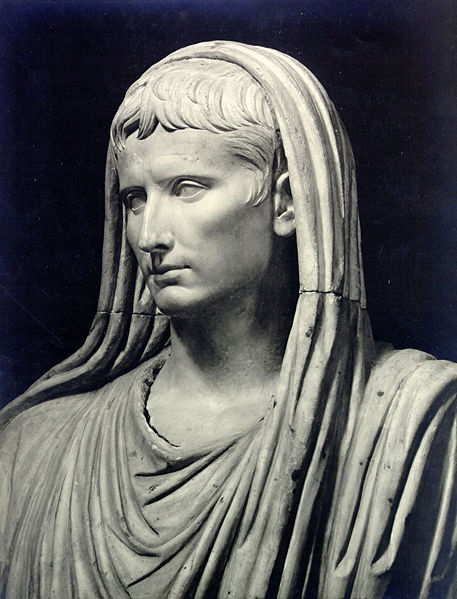
In Roman practise, everyone covered his head during religious observances. There's a statue of the Emperor Augustus Caesar in the role of Pontifex Maximus, and his head is covered since he is performing a religious ritual. St Paul's prescription that men uncover their heads, then, would not seem to be the Roman custom. Jewish men also covered their heads, though I'm unsure of when this became the norm; it may post-date St Paul's writings or may not. I've not researched that.

Outside of religious observances, though, what was the Roman practise? I found Kelly Olson's book to be quite helpful. She focuses more on Rome itself and not the provinces, but the information is still valuable. In the Roman Empire, the prescription was that matrons wore a palla, a long garment that covered most of the body and would be pulled up over the head when out of the house. This only applied to matrons, though, and not unmarried women. Further, it doesn't seem to have applied to married women of the lower classes or to slaves, for the palla would not have been a practical garment if one had to do physical labour. St Paul, however, does not make a distinction between marital status or social class in his command.

In comparing the literary and artistic evidence, Olson contends that wearing the palla was seen as the ideal for the Roman matron, but was not a universal practise. One example is on the Ara Pacis, where women are shown both with and without their heads covered. It is possible, though, that those with their heads uncovered are unmarried girls who would not normally wear the palla anyway. However, there are also numerous portrait busts of matrons, some of which show the palla over the head and some which do not. It would seem, then, that covering the head was ideal (going by the literary evidence), but was not universally practised among Roman matrons (going by the artistic evidence).

Greek dress also dictated that women wear a himation which could cover the head. However, it did not just cover the head, but was more akin to a burka, covering the entire body except for the face. I have also found that Lloyd Llewellyn-Jones' research indicates that Greek women commonly went in public fully veiled, with head and face covered (the source is listed below; I was unable to get the book and so had to rely on the website listed that gave me that source).

St Paul, however, does not make a distinction between marital status or social class in his command. On the contrary, St Paul remarks in places about how all are equal in Christ, so having different rules for citizens and slaves would not be in keeping with that, it seems. St Paul also does not advocate for the more extreme veiling of Greek women which covered the woman completely. He does not seem to be succumbing to cultural mores since he speaks of this as a universal tradition throughout the Church at the time, and it doesn't have absolute parallels in the surrounding cultures in the way it is practised.

My conclusion, then, is that St Paul is not just upholding the cultural mores of the time. He in fact seems to deviate from the cultural prescriptions in many regards by not having different rules based upon social class and marital status. It later becomes the norm that women cover their heads everywhere (St John Chyrosostom speaks of this being the case), but it likely varied from area to area, especially as the Christians went to the farther reaches of the Roman Empire and beyond. So I'm not convinced that one can say that veiling has lost its meaning now that women don't cover their heads any time they are out of the house, since it appears that they did not always cover their heads when leaving the house in St Paul's time, either. Again, I'm not arguing that veiling is mandatory; the Church doesn't say that it is and I will not argue otherwise. I just wanted to research the historical practise a bit.

Llewellyn-Jones, Lloyd (Edt), "Aphrodites Tortoise : The Veiled Woman of Ancient Greece", Classical Press of Wales, December 2002
Cairns, Douglas L. “The meaning of the veil in ancient Greek culture”, Women's Dress in the Ancient Greek World, ed. Lloyd Llewellyn-Jones, p73-94.
Olson, Kelly. Dress and the Roman Woman: Self-Presentation and Society.

21 June 2011

Musings of a Convert

Growing up in a congregation that taught "once saved, always saved" (OSAS) and emphasised a conversion experience, it wasn't uncommon to hear how sad it was that Catholics didn't absolutely know they were saved.  We were taught that we could absolutely know, and that once a person was saved, that was that.  They'd never fall away.

Perhaps it is somewhat ironic, then, that I've felt much more assured, in a way, after leaving behind the OSAS theology (the Catholic Church teaches that one can lose his salvation, because God doesn't keep anyone against his will).  For one, I never had a dramatic conversion experience.  I couldn't point to one time or event and say "that's when I was saved!".  I sometimes felt that was seen as an indication that I wasn't truly saved.  When we had to share our testimonies, I felt I needed to find something in my life that could indicate a more dramatic conversion.  I was unsure a lot of the time.

This uncertainty also came despite the assurances of OSAS apart from the actual conversion experience.  The teaching can lead to a couple of conclusions: that one will never fall away and if one does then he wasn't really saved in the first place, or that one is saved no matter what he does after that point.  The second option is difficult to reconcile with free will, for surely God doesn't take away our free will after we start following Him, which means we are free to leave at any time.  Obviously we can hope and pray that all will return, like the Prodigal Son, but it's not a given.  The first option, though, is what made me unsure.  I'd see people who taught Sunday School go down at the altar call and declare that they'd never been really saved but they were now.  This frightened me.  OK, it terrified me.  These people had been certain of their salvation, but then declared that they hadn't really been saved (as evidenced by some sin they'd committed), but now they were and were sure of it.  The question in my mind was always how they could be certain this time if they thought they'd been certain last time and had been wrong.  I became absolutely terrified of the afterlife and obsessed with wondering if I was truly saved.  I'd repeat the "sinner's prayer" over and over, hoping and praying it would "work".  I didn't talk about those fears really, because I was ashamed.

Fast-forward, then, to when I started to truly study Catholic teaching.  Far from having a hopeless view of salvation, I found it to be full of hope.  The teaching is that one can fall away since we have free will, but by the grace of God it is possible to continue following Him.  I can't answer with an absolute as to whether I'll be saved in the end, because I don't know what I'll do tomorrow.  I can answer for this very moment in time a bit more easily.  I find that this fits in with St Paul's words about working out one's salvation with fear and trembling very well (Phil. 2:12).  To quote another and summarise: "I am saved (Rom. 8:24, Eph. 2:5–8), I am being saved (1 Cor. 1:18, 2 Cor. 2:15, Phil. 2:12), and I have hope that I will be saved (Rom. 5:9–10, 1 Cor. 3:12–15)".

17 June 2011

Children in Mass

Lately I find myself wondering why it's so difficult for others to believe that my children want to go to Mass.  I do not make them go to daily Mass - they ask to go.  Do they stay completely still during Mass?  Of course not.  I expect Kieran not to climb around and not to be loud, but I don't expect him to be silent or completely still.  I expect Charlotte not to be loud and not to run off, which means I have to keep a hand on her.  Both of them get a little restless during the Liturgy of the Word, but both of them are rather more entranced during the Liturgy of the Eucharist, with both of them pointing out the Body and Blood of Christ at the Consecration.  I'm proud of them, and frankly I think they put me to shame at times.

Yet some people just can't seem to imagine that they truly want to be there.  A couple of weeks ago we went to Mass at a different time because we just hadn't gotten ready in time for our usual 8.00 Mass.  We went to the "family Mass", which normally has a children's liturgy where the children are dismissed after the opening prayer and return just before the Liturgy of the Eucharist.  I object to the family being separated during Mass in this way, so my children don't go.  I explain to them that Mass isn't about running around, but about praying and worshipping.  Besides all that, though, is the fact that they want to stay in Mass.  Kieran considers it to be a consequence if he isn't in there.  He wants to be in there "to see Jesus".  Yes, the other children come back in for part of the Mass, but I still don't think it's the ideal.  After that Mass, though, a lady who helps with the children's liturgy mentioned that they could go to that, as if it was just mind-boggling to think they'd want to stay in Mass (or that I'd want them to stay in with me).

This happened again last week; we'd gone to the 8.00 Mass, but we'd gone back for a social event after the 9.30 family Mass.  When I explained that we go to 8.00 Mass, the other lady seemed to assume that I didn't know about the family Mass and the children's liturgy and that I'd surely go to that Mass so I could send my children to the children's liturgy during Mass.  I'll admit that I can't concentrate as much at Mass when I'm trying to ensure the children aren't running around and are being quiet, but I'm still not going to send them to a different liturgy.  When I go to Mass I tell Jesus that I'm there, but I don't know how much of my attention I can offer.  I tell Him that I offer all of myself, such as I am.  Some days go better than others in that regard.  I actually spoke with one of our priests about this, about how I feel bad about not being able to concentrate as much but that I also feel it important that the kids go, and they like to go.  He affirmed that it is important for them to be there with me, and told me to mention Jesus' words about the children coming to Him if anyone criticised me.  I love that priest.

As I mentioned, we go to daily Mass most mornings.  Kieran asks to go, and they kids expect it.  There's a tin of sweeties in the sacristy, but I've explained to Kieran that those are only for Sundays (technically, they're only for the altar servers, but some of the priests include Kieran in getting a sweet).  While the priests would also give him one during the week, I don't want him to go to Mass to get a sweet.  I've talked about it with Kieran, and he understands this, though he does sometimes see if he can get away with getting some chocolate anyway.  One day a well-meaning older lady asked if he'd had his sweet yet just as we were about to leave.  I said that he didn't need one today, and she took his hand anyway and got one for him.  As she did so, she talked about how he deserved one for coming to Mass.  Again there was that assumption that I was making him come to Mass with me.  If he didn't want to go, he could stay home, since my husband doesn't usually leave before we get back.  In fact, he has done that before, though he was later disappointed when he realised it meant he didn't get to go to Mass that day (I think he'd thought he could go later; there are usually two Masses a day at our parish, but there was only one on that day).

Why is it so hard to believe that children want to come to Mass just to come to Mass, and not to play games or get chocolate?

14 June 2011

Journal

I used to journal regularly.  It was my routine that before bed I'd jot down my thoughts.  Anyone who knows me knows that my writing is nigh illegible when I write fast, but I didn't write it in order to read it again later, but just to get the thoughts out of my head.  It really helped me to sleep, actually.

Since having kids, I've largely dropped this habit.  When the kids are little, I often end up falling asleep with them.  I also tend to read before bed instead, since I can easily do that whilst nursing Charlotte.

My parents gave me a beautiful leather journal a couple of years ago, but even that hasn't induced me to journal regularly again.  However, I'm not putting it to good use again.  Since I'm staying off the computer more, I started using part of the journal to jot down my thoughts or reminders during the day.  I've decided to use another section of it to jot down all the prayer requests I come across so I can be better at remembering them to God.  I often forget the specific requests when I'm before Jesus in the Eucharist, and while I know He knows what they are, it will be nice to bring the journal before Him.  Hopefully I can just remember to keep it with me so I can write down requests and bring them before God.

13 June 2011

St Anthony of Padua

Today is the feast day of St Anthony of Padua, who is my patron Saint for the year and is one of my son's Saints.  That being the case, I thought I'd post this snippet regarding a miracle associated with him.
The miracle of St. Anthony of Padua is well known. He was preaching on the truths of the faith to a large crowd in Rimini, when he was challenged by a Jew, who denied the truth of the Eucharist, saying: "You confound me by your words, because you are more learned than I am, but let us come to deeds; prove it to me by them." St. Antony accepted the challenge, and permitted the Jew to name the proof he required. A mule was kept without food for three days, and at the end of the time the Jew, accompanied by a great crowd, led it out to the place in which he was to meet the Saint. The latter was celebrating Mass, and when he reached the Communion he went forth with the Sacred Host, and turning to the mule said: "In the name of Jesus Christ, Whom I, though unworthy, hold in my hands, I command you to come forth and do reverence to your Creator, that you may confound these heretics." The Jew now threw a handful of hay and oats to the hungry animal, but at a sign from the Saint it left them untouched, although famishing with hunger, and approaching the Saint bent its knees before him, and bowed its head as a mark of veneration. The miracle was plain for all: the Jew, as well as others, was converted. A chapel was erected on the spot in memory of the event, and is preserved to the present day.
The Real Presence Of Jesus Christ In The Eucharist
Cardinal Gaetano De Lai

11 June 2011

Musings of a Convert

There are not one hundred people in the United States who hate The Catholic Church, but there are millions who hate what they wrongly perceive the Catholic Church to be.
The above quote is from Archbishop Fulton Sheen, and I've found it to be fairly accurate, at least in my own experience.  I was raised Southern Baptist, but converted to Catholicism in 2004.  Here are some of the more common misconceptions I've encountered, either in my own understanding or in others.

-Purgatory.  This is a pretty big one, really.  The usual misconceptions are that purgatory is some kind of "second chance" and/or that it negates Jesus' sacrifice and instead focuses on earning your way to Heaven.  In fact, neither of these are true.  I mentioned that I was raised Southern Baptist, in a congregation that taught "once saved, always saved"; if asked what would happen to the person who still held on to some sin at death, some would answer that those sins, or any attachment to sin, would be immediately burned away and cleansed upon death.  Well, that's essentially purgatory.  We don't know how long it may take for this cleansing, but it could be in the blink of an eye.  This doesn't negate Jesus' sacrifice, but is the application of His sacrifice after our death for those of us who die while still in some attachment to venial sin.  It's a great act of mercy from God to cleanse us in this way so we can enter Heaven.

-Faith/Works.  Purgatory leads to me the discussion on faith and works.  Many seem to think that Catholics believe they can earn their way to Heaven through various works.  In fact, Church teachings are very clear that salvation is by grace alone, through faith and works.  This doesn't mean that we earn our way, but it does mean that we can't just say we believe and then not live it out.  After all, St James tells us that faith without works is dead.  The parable of the sheep and goats makes it clear that our actions matter.  Again, this doesn't mean that we earn our salvation - it is only by the grace of God, and He also gives us the grace to perform these actions.

There are many more, but I'll stop with just those for now.  :-)

29 May 2011

Body of Christ

I'm trying to stay off-line as much as possible on Sundays, so I thought over the next few Sundays I'd just post my thoughts, such as they may be, on the Anima Christi prayer.  It's one of my favourite prayers, and one I say daily. Here's the full text:

Soul of Christ, sanctify me
Body of Christ, save me
Blood of Christ, inebriate me
Water from the side of Christ, wash me
Passion of Christ, strengthen me
O good Jesus, hear me
Within Thy wounds hide me
Suffer me not to be separated from Thee
From the malicious enemy defend me
In the hour of my death call me
And bid me come unto Thee
That with thy Saints I may praise Thee
For all eternity
Amen

Body of Christ, save me.

This line is one of my favourites.  When I was researching Catholicism, it was when I realised the truth of the Eucharist that I knew I had to convert.  I cannot explain or describe the pure love and joy even in kneeling before Jesus in the Blessed Sacrament at Adoration, or exclaiming with the Apostle Thomas "My Lord and my God!" at the Elevation of the Host.  Jesus gives us His Body in the humble form of the Eucharist, telling us we must partake of His Flesh and Blood to have life within us (see John 6).  When we unite ourselves with Jesus in this way, we are slowly transformed by His grace so He may save us.  It is amazing how He humbles Himself in order to be so completely united with us.