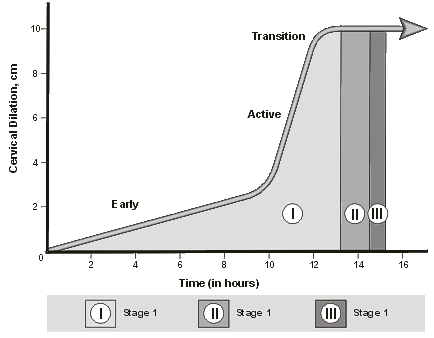
The other major problem I have with this is the use of cervical checks to assess a woman's progress. While I understand this might be indicated with an induction, or epidural, or if a woman's labour appears to have stalled, in general I don't think they give a good picture of what the woman's body will do. Yes, it can tell you what her body has done, and in what amount of time, but that doesn't translate to a prediction of what her body will do. I also think there's a danger of going by dilation alone and ignoring the woman as a whole. That was certainly my case when I was in labour with K, and one reason I refused any internal exams with C (my midwife with her was happy with this and said she could tell my progress without doing an internal exam). With K, I consented to a cervical check after a few hours of active labour, and was at 3cm. Even though I was showing signs of being in transition (nauseated and saying "I can't"), the midwife didn't seem to consider that I could be in transition because I was only dilated to 3cm. She was incredibly surprised when I was fully dilated and pushing an hour later. In case you're wondering, the other reason I refused any internal exams with C was because of the increased risk of infection. I know it's a lower risk, since my waters hadn't broken, but one I didn't feel was necessary to take.
Something I found interesting in this study is that nearly half of the women received pitocin, and 80% had epidurals. While pitocin is chemically identical to the natural oxytocin made by the body, the body reacts quite different to it. For one, pitocin is administered in a constant stream via an IV drip, while oxytocin is released in bursts via the pituatary gland, and also triggers the release of endorphins to lower the perception of pain. Because pitocin doesn't cross the blood-brain barrier, the endorphins are not released, and thus many women find that contractions with pitocin are more painful. Now, since the body responds differently to pitocin than to natural oxytocin, it seems logical to assume that labour patterns are different between the two groups. Therefore, to truly assess women's natural labour patterns, it seems better, in my opinion, bearing in mind that I have no medical training, to look at the group who did not have their labour augmented with pitocin to see what happened.
On to the epidural. Epidurals can lower blood pressure and slow labour. The fact that 80% of the women surveyed had received an epidural would surely skew the numbers a bit. And since continuous foetal monitoring is often used with both pitocin and epidurals, the majority of these women would be confined to bed, which can also have an effect on the length of labour. If these things are affecting labour length, I'd think it probable that they're also affecting the rate of cervical dilation, and thus skewing the results. Please note I'm not necessarily against pitocin or epidurals in all situations, but I do think their use is skewing the perception of what a physiological labour and delivery is.
