While making scones I was thinking about how breastfeeding and childbirth have been damaged by the attempt to make them more "scientific". (yes, I have random thoughts when baking, or any time, really) My train of thought then went to my days of studying archaeology and learning about "New Archaeology" (or Processual Archaeology), wherein some declared that what archaeology needed was to be more scientific. I find it interesting that these major interests of mine can be united by the fact that all, at one time or another, were under some kind of pressure to conform to a scientific method. With breastfeeding and childbirth, this took the form of schedules and time limits and various procedures, instead of going with the natural flow of things; with archaeology this took the form of putting archaeology under anthropology and trying to be more scientific in analysing artefacts and an assumption that all aspects of a culture could be analysed through the material record.
Now, science certainly has its place within the study of breastfeeding, childbirth, and archaeology, and the scientific study of these things has led to greater understanding in some ways. The problem, however, comes in trying to force these things to fit within a certain framework (obviously it's a bit different with archaeology, since we're not talking about a natural biological function but the study of past societies and that study must be thorough and rigorous, but the human element still remains). Thankfully "new archaeology" was soon criticised for its shortcomings, and thankfully the "scientific" rules for breastfeeding are, in general, no longer in vogue. We're getting there with childbirth, but there's still a ways to go.
The underlying assumption, really, is that the unpredictability and organised chaos of human systems is somehow deficient and inferior to a purely logical, scientific approach. Seeing as we are not Vulcans, though, our bodies and societies do not, and will never, conform to a rigid system. This is part of the beauty of breastfeeding, childbirth, and archaeology, in my opinion. The way science can, and has, helped in these areas is by giving us greater understanding of them instead of trying to force them to conform to arbitrary standards in the name of "science".
Showing posts with label archaeology. Show all posts
18 July 2011
23 June 2011
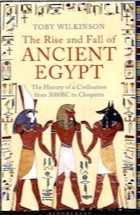
Book Review: The Rise and Fall of Ancient Egypt
I've just finished reading Toby Wilkinson's new book
. It's quite an ambitious goal, to outline the history of Egypt from the early dynastic period to Cleopatra. The very scope necessitates that he cannot go into great depth for any one period, and that much must be omitted. That being said, I think that overall he does a good job of presenting the big picture, and doing so in a way that is accessible to non-Egyptologists. I wouldn't say it's for those who know nothing of ancient Egypt, but it also doesn't assume great knowledge of Egyptian archaeology.
Wilkinson takes a bit of a different view of pharaonic society than that given in many books. That is, he does not glorify the Pharaohs, but speaks instead of their despotic qualities. In some ways I think his portrayal is a bit too reactionary in his effort not to glorify the Pharaohs. Of course the Pharaohs were autocrats, but the real picture is almost always more nuanced than an either/or scenario. I will say that he becomes a bit less scathing in his discussion of later (New Kingdom and later) Pharaohs. Perhaps this is in part because he seems to have done more work on the Early Dynastic period and therefore is more intimately familiar with them, leading him to also be more critical of the rulers of that period. They were a bit more ruthless then, seeing as human sacrifice and the killing and burying of the household with the Pharaoh were still practised then. His dim view of them, then, isn't entirely unjustified, though I think a more nuanced view would be best.
On the other hand, I thought he allowed too much of the sensationalism around the Amarna period to seep in. For example, he still gives the speculation that Tutankhamun may have been murdered. While there isn't a definitive explanation of his death yet, the general consensus is that it was an accidental death due to an infected broken leg and malaria. I do understand his inclusion of this, for it is difficult not to fall prey to the sensationalism that often surrounds the Amarna period. Tutankhamun has captured the public imagination, and speculation is often rife. When writing a book marketed to the general public and not just to academics, it is understandable to include a bit of sensationalism.
The most infuriating thing for me was a short sentence in the epilogue: "the deep wellspring of ancient Egyptian religion proved a fertile source for the development of early Christianity: for Isis and Horus, substitute Virgin and Child - the iconography (and much of the underlying theology) remained virtually identical". Other than the depiction of mother and infant for both Isis and Horus and the Blessed Virgin Mary and Jesus, I don't see overwhelming similarities either in iconography or theology. Horus' was not a virgin birth, and Mary is not a goddess. Isis did flee with Horus to protect him from Seth, so a parallel could perhaps be made to the flight into Egypt by the Holy Family, though the circumstances are different. The mother-child pairing is a universal human experience, so the prevalence of mother-infant dyads in religious art across various religions really isn't surprising. That being said, this does not necessarily indicate that the theology is the same, since the rest of the Isis/Horus myth is not all that analogous to orthodox Christian belief.
Now that I've gotten my criticisms out of the way, I hope that I've not given an impression that I disliked the book. Far from it. In fact, I'll say that overall this book is well-done. It is wonderful to have a book that gives a more detailed overview of Egyptian pharaonic history. The colour plates and numerous black-and-white photos included are invaluable in picturing the people and monuments, or recalling them to mind if one is already familiar with them. I also quite enjoyed Wilkinson's dry sense of humour that permeates the narrative. For those who know something of ancient Egypt and wish to have an overview of all of pharaonic history, this is a good book. The list of sources is also invaluable.
Wilkinson takes a bit of a different view of pharaonic society than that given in many books. That is, he does not glorify the Pharaohs, but speaks instead of their despotic qualities. In some ways I think his portrayal is a bit too reactionary in his effort not to glorify the Pharaohs. Of course the Pharaohs were autocrats, but the real picture is almost always more nuanced than an either/or scenario. I will say that he becomes a bit less scathing in his discussion of later (New Kingdom and later) Pharaohs. Perhaps this is in part because he seems to have done more work on the Early Dynastic period and therefore is more intimately familiar with them, leading him to also be more critical of the rulers of that period. They were a bit more ruthless then, seeing as human sacrifice and the killing and burying of the household with the Pharaoh were still practised then. His dim view of them, then, isn't entirely unjustified, though I think a more nuanced view would be best.
On the other hand, I thought he allowed too much of the sensationalism around the Amarna period to seep in. For example, he still gives the speculation that Tutankhamun may have been murdered. While there isn't a definitive explanation of his death yet, the general consensus is that it was an accidental death due to an infected broken leg and malaria. I do understand his inclusion of this, for it is difficult not to fall prey to the sensationalism that often surrounds the Amarna period. Tutankhamun has captured the public imagination, and speculation is often rife. When writing a book marketed to the general public and not just to academics, it is understandable to include a bit of sensationalism.
The most infuriating thing for me was a short sentence in the epilogue: "the deep wellspring of ancient Egyptian religion proved a fertile source for the development of early Christianity: for Isis and Horus, substitute Virgin and Child - the iconography (and much of the underlying theology) remained virtually identical". Other than the depiction of mother and infant for both Isis and Horus and the Blessed Virgin Mary and Jesus, I don't see overwhelming similarities either in iconography or theology. Horus' was not a virgin birth, and Mary is not a goddess. Isis did flee with Horus to protect him from Seth, so a parallel could perhaps be made to the flight into Egypt by the Holy Family, though the circumstances are different. The mother-child pairing is a universal human experience, so the prevalence of mother-infant dyads in religious art across various religions really isn't surprising. That being said, this does not necessarily indicate that the theology is the same, since the rest of the Isis/Horus myth is not all that analogous to orthodox Christian belief.
Now that I've gotten my criticisms out of the way, I hope that I've not given an impression that I disliked the book. Far from it. In fact, I'll say that overall this book is well-done. It is wonderful to have a book that gives a more detailed overview of Egyptian pharaonic history. The colour plates and numerous black-and-white photos included are invaluable in picturing the people and monuments, or recalling them to mind if one is already familiar with them. I also quite enjoyed Wilkinson's dry sense of humour that permeates the narrative. For those who know something of ancient Egypt and wish to have an overview of all of pharaonic history, this is a good book. The list of sources is also invaluable.
5 February 2011
On Being a SAHM
While I knew I wanted children, and I wasn't always sure about working outside the home, I wasn't at all convinced that I'd willingly be a stay-at-home-mum and actually enjoy it. I've always been a bit of a homebody, but at the same time get bored if at home day after day. Nor have I ever enjoyed babysitting. It has therefore come as quite a surprise to me to find that I truly enjoy being a SAHM, and in fact get a bit stressed if I think about working outside the home.
This didn't happen overnight, of course. I fell pregnant whilst completing my MA in Egyptology. I'd already planned to continue on to the PhD and had been conditionally accepted, pending submission of my MA dissertation. I submitted that at the end of September, and started the PhD in October. Since K was due in late November, I figured the timing was just about perfect, as I would only miss a week or two of classes before Christmas break, and then would have off until the end of January. A friend told me that I wouldn't want to come back, but I didn't pay much attention to that at the time, though obviously it's stayed in my mind. Now, I know part of the reason for that is that I knew I wasn't allowed to take a maternity leave, given that I was on a student visa. But I also couldn't imagine being happy staying at home with a baby and stopping my studies. I'd been working part-time at the university throughout my pregnancy and planned to come back to that in the spring semester.
On 29 November, at exactly 40 weeks, I gave birth to K. I was transformed by motherhood, and it all seemed to come naturally to me. I found that I was breastfeeding on demand, co-sleeping, babywearing: in short, I was following Attachment Parenting, without even knowing what that was at the time. Even so, I didn't imagine that I wouldn't continue with my PhD, so when January rolled around, I returned to the university. My primary supervisor was more than happy for me to bring K along to meetings and classes, which I appreciated immensely. While we didn't always see eye-to-eye, his welcoming attitude towards me having K with me was wonderful. I was also able to bring K to work with me, though I did work fewer hours at that point. I've joked that K was probably confused about language, given that he accompanied me to French and Middle Egyptian lectures. He even attended a lecture by John Baines, who thankfully was happy for K to be in there, and even joked about it when K cried after a person criticised Baines' conclusions.
As time went on, though, I was becoming more and more stressed about continuing the PhD. I've never been a fan of archaeological theory, as much as I love archaeology. My supervisor and I also have very different personalities and seemed to be speaking past each other a lot, leading to frustration on both sides. So I decided that what I needed was to change supervisors. In the back of my mind I thought maybe I'd prefer staying at home, but I didn't allow myself to think about it too much, since I was still on a student visa and therefore couldn't stop my studies. However, I knew that something had to change, so we talked to the international student office and learnt that I could put myself as a dependent on B's visa and then switch to part-time status. Between that and changing my supervisor, I figured that would be satisfactory.
Only it wasn't. I was still getting more and more stressed and was unhappy with the PhD. That continued until I had tonsilitis when K was 9 months old and then ended up having a panic attack because of worrying that I couldn't care for K if I was ill. I didn't know it was a panic attack, nor did B, so he rang for an ambulance. They realised that it was a panic attack and spoke to me about it, and I finally admitted how stressed I was and that I didn't want to continue with the PhD. I'd not voiced those feelings before, but had kept them to myself. The EMT spoke to B and told him I must be allowed to be a SAHM. B had had no idea I'd felt that way (seeing as I hadn't told him), but he was very supportive. We crunched numbers and figured out how we could cut expenses, and I turned in my notice of withdrawing from the PhD programme. From then on, I've been a SAHM, and I've not regretted it for a day. I love the time playing with the kids, getting to bake our breads, having the opportunity to home educate, and I look forward to many more days and years of this.
This didn't happen overnight, of course. I fell pregnant whilst completing my MA in Egyptology. I'd already planned to continue on to the PhD and had been conditionally accepted, pending submission of my MA dissertation. I submitted that at the end of September, and started the PhD in October. Since K was due in late November, I figured the timing was just about perfect, as I would only miss a week or two of classes before Christmas break, and then would have off until the end of January. A friend told me that I wouldn't want to come back, but I didn't pay much attention to that at the time, though obviously it's stayed in my mind. Now, I know part of the reason for that is that I knew I wasn't allowed to take a maternity leave, given that I was on a student visa. But I also couldn't imagine being happy staying at home with a baby and stopping my studies. I'd been working part-time at the university throughout my pregnancy and planned to come back to that in the spring semester.
On 29 November, at exactly 40 weeks, I gave birth to K. I was transformed by motherhood, and it all seemed to come naturally to me. I found that I was breastfeeding on demand, co-sleeping, babywearing: in short, I was following Attachment Parenting, without even knowing what that was at the time. Even so, I didn't imagine that I wouldn't continue with my PhD, so when January rolled around, I returned to the university. My primary supervisor was more than happy for me to bring K along to meetings and classes, which I appreciated immensely. While we didn't always see eye-to-eye, his welcoming attitude towards me having K with me was wonderful. I was also able to bring K to work with me, though I did work fewer hours at that point. I've joked that K was probably confused about language, given that he accompanied me to French and Middle Egyptian lectures. He even attended a lecture by John Baines, who thankfully was happy for K to be in there, and even joked about it when K cried after a person criticised Baines' conclusions.
As time went on, though, I was becoming more and more stressed about continuing the PhD. I've never been a fan of archaeological theory, as much as I love archaeology. My supervisor and I also have very different personalities and seemed to be speaking past each other a lot, leading to frustration on both sides. So I decided that what I needed was to change supervisors. In the back of my mind I thought maybe I'd prefer staying at home, but I didn't allow myself to think about it too much, since I was still on a student visa and therefore couldn't stop my studies. However, I knew that something had to change, so we talked to the international student office and learnt that I could put myself as a dependent on B's visa and then switch to part-time status. Between that and changing my supervisor, I figured that would be satisfactory.
Only it wasn't. I was still getting more and more stressed and was unhappy with the PhD. That continued until I had tonsilitis when K was 9 months old and then ended up having a panic attack because of worrying that I couldn't care for K if I was ill. I didn't know it was a panic attack, nor did B, so he rang for an ambulance. They realised that it was a panic attack and spoke to me about it, and I finally admitted how stressed I was and that I didn't want to continue with the PhD. I'd not voiced those feelings before, but had kept them to myself. The EMT spoke to B and told him I must be allowed to be a SAHM. B had had no idea I'd felt that way (seeing as I hadn't told him), but he was very supportive. We crunched numbers and figured out how we could cut expenses, and I turned in my notice of withdrawing from the PhD programme. From then on, I've been a SAHM, and I've not regretted it for a day. I love the time playing with the kids, getting to bake our breads, having the opportunity to home educate, and I look forward to many more days and years of this.
Subscribe to:
Posts (Atom)